Most teams pick AI task software on price alone, then discover the real cost at renewal. Per-member billing quietly multiplies as you hire, and many platforms lock features behind tiers you never budgeted for. Knowing the models before you buy changes what you negotiate.
This article breaks down per-member, per-team, and flat-rate pricing, explains why per-member dominates, and details what Tasks.Bot's ₹200 monthly or ₹1,200 yearly full access plan includes. You will also learn which features justify the spend, who should pay, and who should walk away.
What Is Tasks.Bot? AI Team Assignment Automation via WhatsApp
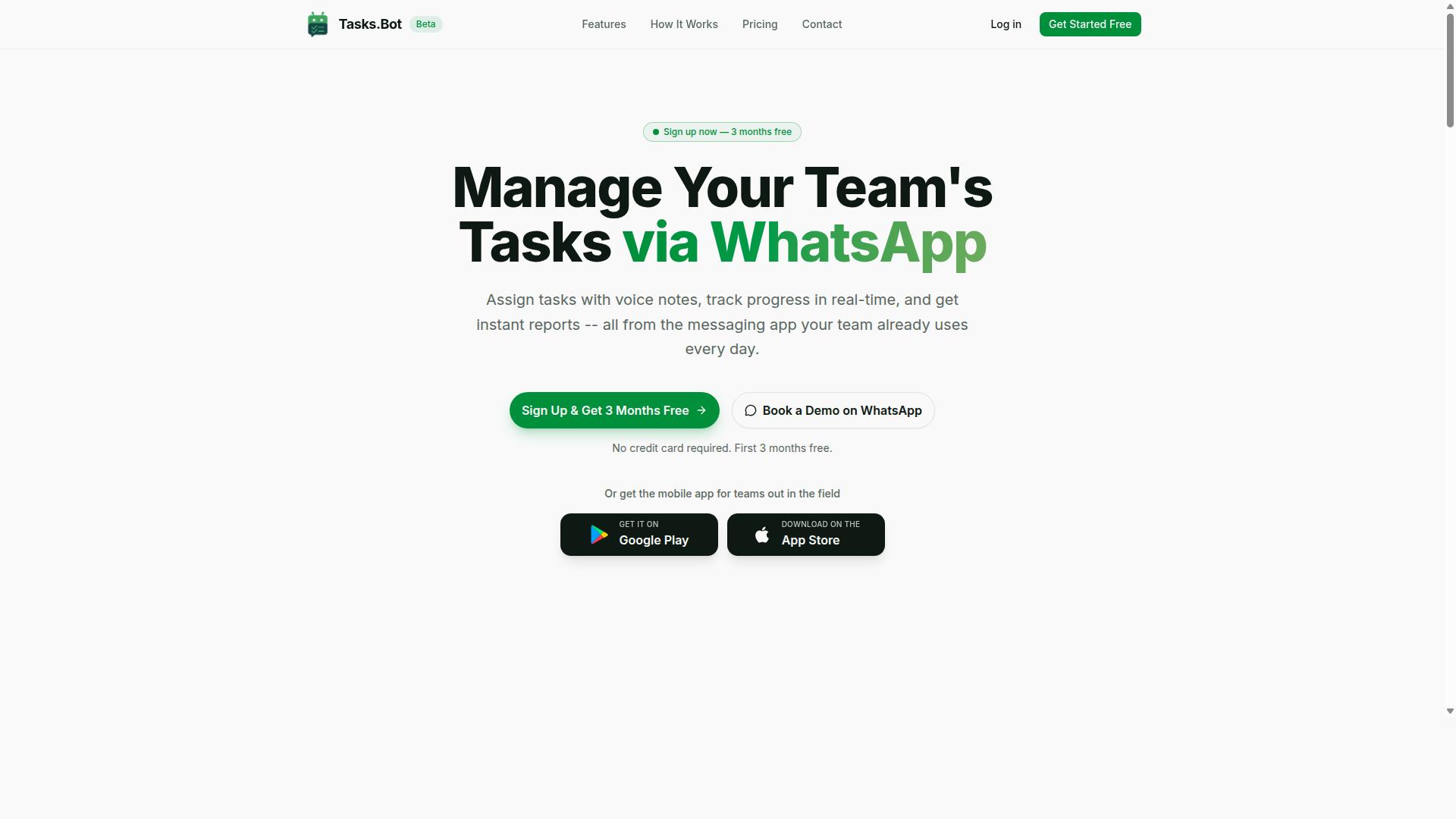
Tasks.Bot is a task management platform that operates entirely within WhatsApp, allowing teams to assign tasks, track progress, and receive reports without leaving the messaging app. Instead of asking employees to learn another dashboard, it meets them in a tool they already open dozens of times a day.
That design choice matters when you are evaluating AI team assignment automation software and its pricing. The more software a team must adopt, the more onboarding time, training expense, and quiet resistance you absorb. Tasks.Bot sidesteps most of that by using WhatsApp as the primary interface.
Tasks.Bot is a SaaS product, so it follows the subscription logic common to this category: you pay for ongoing access rather than a one-time license. The service is currently in beta and offers a free trial period, which gives buyers a way to test fit before committing budget.
Here is what the platform does at a functional level:
- Voice note task creation, so a manager can speak a task instead of typing it
- Automatic task assignment, routing work to the right person without manual sorting
- Smart deadline reminders, keeping due dates visible inside the chat thread
- Instant reports, giving visibility into progress without a separate reporting tool
For teams working outside an office, Tasks.Bot also offers a mobile app for field staff. That matters for pricing conversations, because field and desk-based roles often need different levels of access, and per-seat licensing models usually price them the same.
The core value proposition is straightforward: task allocation and follow-up happen inside an app teams already use. Fewer logins, less training, and a shorter path from "task created" to "task done."
When you compare vendors later in this article, keep that lens handy. A lower sticker price on a platform nobody uses costs more than a slightly higher subscription that people actually adopt. Tasks.Bot's WhatsApp-first approach is its answer to that adoption problem.
What Should You Pay for AI Team Assignment Automation Software?
Understanding the pricing landscape for AI team assignment automation software helps you budget effectively and compare vendors on an apples-to-apples basis. Prices vary widely because vendors bundle different capabilities, support levels, and deployment options into their plans.
Three factors drive most of the variation: the number of users who need access, the depth of the feature set, and whether the tool runs in the cloud or on your own infrastructure. A small startup with a handful of coordinators will see very different quotes than a large department managing hundreds of assignments per week.
Feature depth matters just as much as headcount. Basic task allocation may come standard, while advanced routing logic, workload balancing, and analytics often sit behind higher tiers. Buyers should map their must-have capabilities before requesting quotes.
Beyond the subscription itself, total cost of ownership includes onboarding, training, and integration work. These one-time or recurring expenses can shift the real cost meaningfully, so they belong in any budget allocation exercise.
Most tools on the market fall into one of three structures: per-member, per-team, or flat-rate. Some vendors blend these approaches or add usage-based components on top. The sections below break down each model so you can match one to your organization's size and growth plans.
Typical Pricing Models: Per-Member, Per-Team, and Flat-Rate Plans
AI team assignment software generally follows one of three pricing structures: per-member (per-seat), per-team, or flat-rate. Each shifts risk and cost differently between buyer and vendor.
Per-member pricing charges a set fee for each user who needs access. Costs scale directly with headcount, and many vendors offer volume discounts as seat counts rise. This model suits growing teams because you add seats only when you add people.
Per-team pricing sets a fixed price for a defined group of users, regardless of exactly how many people are inside that group. It can be cost-effective for small, stable teams that rarely change size. Larger departments, however, may find the group limits restrictive.
Flat-rate pricing charges one price no matter how many users participate, but usually comes with usage caps or feature limits. It works well for stable small teams that want predictable bills without tracking seats.
- Per-member: best for growing teams and organizations that hire frequently
- Per-team: best for small departments with steady membership
- Flat-rate: best for stable small teams with modest usage
Some vendors offer hybrid models that combine a flat platform fee with per-seat charges above a threshold. Others layer usage-based pricing on top for API access or high-volume task routing. When comparing quotes, ask each vendor to spell out which model applies and where the boundaries sit.
Why Per-Member Pricing Dominates AI Task Assignment Tools
Per-member pricing is the most common model for AI task assignment tools because it aligns cost with value delivered to each user. Every person who receives intelligent task routing, workload visibility, or assignment recommendations gets full access under the same terms.
For buyers, the appeal is predictability and transparency. You know the cost per user up front, which simplifies budget allocation and procurement. Finance teams can forecast spend as headcount changes, and there are no surprises tied to usage spikes.
For vendors, per-seat licensing produces recurring revenue that scales naturally with customer growth. That stability funds ongoing development, support, and infrastructure, which in turn benefits subscribers.
The main drawback is cost at scale. A large organization with hundreds of users can face a significant annual bill. Volume licensing and tiered discounts are the usual remedy, and most vendors publish discount thresholds or negotiate them during contract talks.
Compared with per-team and flat-rate fees, per-member pricing handles growth more gracefully. Per-team plans force awkward renegotiation when a group expands, while flat-rate plans often cap usage in ways that frustrate larger teams. Per-seat licensing avoids both problems, which explains its dominance in this category.
When evaluating quotes, ask how seat counts are defined, whether read-only users count, and what happens mid-contract if your team shrinks. Clear answers on these points make vendor comparison far easier.
Tasks.Bot Pricing: Full Access at ₹200/Month or ₹1,200/Year per Member
Tasks.Bot offers a single 'Full Access' plan priced at ₹200 per member per month or ₹1,200 per member per year, with all features included. There is no confusing menu of starter, growth, or enterprise editions to sort through.
Pricing is available in Indian Rupees (₹) and US Dollars ($). The site includes a "Select currency" option, so teams should confirm which currency applies before they commit to a plan.
The annual plan works out to a 50% saving, equivalent to roughly two months free compared with paying month by month. For a ten-member team, that difference adds up quickly across a year of use.
This flat, per-member structure makes budgeting straightforward. Instead of estimating usage tiers or watching for overage charges, a team simply multiplies the rate by the number of people who need access.
What the Full Access Plan Includes - Every Feature, No Tiers
The Full Access plan includes every feature Tasks.Bot offers, with no artificial limits or upsells. Every member on the plan gets the same complete toolkit, regardless of role or seniority.
The feature set covers a wide span of day-to-day team operations:
- Voice note task creation
- Automatic task assignment
- Smart deadline reminders
- Approvals and automations
- Instant reports
- Tasks on a map and a live day tracker
- Face-verified attendance
- Shifts, leave, and hours management
- Tasks on mobile apps for Android and iOS, with push notifications, voice capture, and a home screen widget
- Native WhatsApp integration
Because the service runs through WhatsApp, the AI can understand user intent and create tasks directly from messages. That means task allocation happens where conversations already take place, not in a separate tool nobody opens.
This simplicity matters for procurement. Teams don't have to guess which tier they need, compare feature matrices, or worry that a capability they rely on sits behind a higher price point. For teams with varied roles, from field staff to managers, one plan keeps everyone on equal footing.
3 Months Free, No Credit Card: How to Evaluate Before You Pay
Tasks.Bot offers a 3-month free trial with no credit card required, giving teams ample time to test the platform in real workflows. New users can cancel anytime, so there is no lock-in during the evaluation period.
Three months is enough time to move past a surface-level look. Teams can onboard members, run real tasks through the system, and judge whether the software earns its place in the budget.
A few practical checks make the trial more useful:
- Test voice note task creation with actual instructions from the field
- Check face-verified attendance accuracy against your existing process
- Generate instant reports and see whether they answer the questions managers actually ask
- Run approvals and automations through a full cycle to spot friction early
This low-risk approach reduces procurement friction. There is no upfront payment, no credit card on file, and no pressure to decide before the team has seen the tool handle its own work.
If the trial confirms the fit, moving to a paid plan is a simple per-member calculation. If it doesn't, the team walks away with no cost and a clearer picture of what it needs. Either way, the decision rests on evidence rather than a sales pitch.
Key Features That Justify the Price
Tasks.Bot's pricing is justified by features that directly address common pain points in team coordination and field operations. Two capabilities stand out: AI-powered task creation and face-verified attendance with GPS tracking. These are not optional extras bolted onto a basic task list. They sit at the center of how the platform automates assignment and enforces accountability.
When you compare subscription models across AI team assignment automation software, it helps to separate tools that merely store tasks from those that actively reduce manual work. A simple checklist app may cost less per seat, but it still depends on a manager typing every instruction, chasing every update, and trusting self-reported hours.
Tasks.Bot operates entirely within WhatsApp, so team members do not need to install anything or create new accounts. That design choice lowers onboarding friction and training expenses, two line items that often inflate the total cost of ownership far beyond the sticker price.
The sections below explain how each feature works and why it matters when you weigh subscription cost against real operational value.
AI Task Creation from Voice Notes and Natural Language
Tasks.Bot uses AI to interpret voice notes and natural language, turning spoken instructions into assigned tasks automatically. A manager can send a voice note or type a message in plain language, and the platform creates the task. There is no form to fill in and no dropdown menu to navigate.
Consider a concrete example. A manager sends a voice note saying, "Assign John to inspect site A tomorrow at 10 AM." The task is created and assigned without anyone opening a dashboard or typing a single field. That is the kind of task allocation speed that manual entry simply cannot match.
The practical benefits show up quickly:
- Less manual data entry, which frees supervisors to focus on the work itself
- Faster task allocation, since instructions become assignments in one step
- Fewer transcription errors, because the original instruction drives the task record
This feature is included in the Full Access plan, which matters for budget allocation. Buyers do not pay a separate AI add-on fee or a per-message automation charge. The capability is part of the core subscription, and Tasks.Bot also offers a 3-month free trial with no credit card required, so teams can evaluate the workflow before committing budget.
Face-Verified Attendance, GPS Tracking, and Payroll-Ready Hours
For field teams, Tasks.Bot offers face-verified attendance and GPS tracking to ensure accurate time logs and payroll-ready hours. Team members check in through the mobile app, which verifies their identity and records their location. That data feeds into timesheets that can be exported for payroll, cutting down on administrative overhead.
For businesses with field staff, the value is straightforward. Face verification helps eliminate buddy punching, where one worker clocks in for another. Live GPS tracking gives managers real-time location data during the workday. Together, these records support accurate client billing, since hours worked and sites visited are documented rather than estimated.
These capabilities are part of the Full Access plan and contribute to ROI in two ways. First, they reduce time theft by tying attendance to a verified identity. Second, they shrink manual tracking effort, since timesheets no longer depend on paper logs or end-of-week reconstruction. Tasks.Bot also provides shifts, leave, and hours management alongside face-verified attendance, so scheduling and payroll preparation sit in the same system.
When evaluating enterprise pricing or mid-market pricing, it is worth asking whether attendance verification costs extra. Here it does not. The feature ships within the same plan as AI task creation, which simplifies vendor comparison and keeps the total cost of ownership easier to forecast.
Who Should Pay for Tasks.Bot - and Who Shouldn't
Tasks.Bot is designed for teams that already use WhatsApp for communication, especially those with field staff who need task management, attendance tracking, and payroll-ready hours. If that description fits your operation, the pricing structure is built around you rather than against you. If it does not, this section will help you decide honestly whether to look elsewhere.
The service mentions hundreds of teams already using it, which tells you the product has found a real audience rather than chasing every possible buyer. Understanding that audience is the fastest way to judge whether the per-member cost makes sense for your budget.
Small to mid-sized teams (roughly 5 to 50 members) are the clearest fit. At this size, per-member pricing stays predictable and affordable, and you avoid the overhead that enterprise-grade solutions often carry. Teams in construction, field services, and retail tend to benefit most because their staff are mobile, their communication already runs through WhatsApp, and their admin work revolves around tracking who did what and when.
For these groups, the value is straightforward. Task allocation, attendance tracking, and payroll-ready hours all live in a channel employees already check every day. That means less training expense, faster onboarding, and a lower total cost of ownership than rolling out a separate app nobody wants to open.
Who should think twice? Consider the following situations carefully before committing budget:
- Large enterprises with complex workflows that depend on deep integrations across many internal systems. Tasks.Bot is not positioned as an enterprise-grade platform for that kind of architecture.
- Teams that do not use WhatsApp. The entire value proposition rests on meeting staff where they already communicate. Without that, you lose the main advantage.
- Organizations needing extensive customization. If your processes require heavy bespoke configuration, a general-purpose tool may frustrate more than it helps.
None of this makes Tasks.Bot a weak product. It makes it a focused one. A tool built for field teams that live in WhatsApp will outperform a sprawling platform that tries to serve everyone and masters nothing.
If you are weighing subscription models, remember that per-seat licensing rewards teams who know their headcount and keep it stable. A 5 to 50 person operation can forecast that cost with confidence, which makes budget allocation and procurement simple. There is no need to negotiate custom pricing or volume licensing when the standard plan already fits.
The honest verdict: if your team communicates on WhatsApp and manages field or shift-based work, Tasks.Bot is priced for you and worth the spend. If you run a large enterprise with layered systems, or your staff never touch WhatsApp, your money is better placed elsewhere. Self-select on those two questions, and the decision becomes clear.
Final Verdict: Is Tasks.Bot Worth the Price?
Tasks.Bot offers a compelling value proposition for WhatsApp-centric teams, with transparent per-member pricing and a generous free trial. There is one Full Access plan, priced at ₹200 per month or ₹1,200 per year per member. No confusing tiers, no feature gates, and no need to guess which package fits your team.
That simplicity matters when you are comparing AI team assignment automation software. Many tools bury core capabilities behind higher-priced plans, which inflates the real cost once you add seats. Here, every member gets the same access from day one.
The risk of trying it is low. Tasks.Bot includes a 3-month free trial, which is longer than the short windows typical of the category. For a small team, that is enough time to see whether task allocation and attendance tracking actually reduce daily coordination effort.
Key features include AI task creation and face-verified attendance. The first speeds up how work gets logged and assigned. The second gives field and shift-based teams a reliable way to confirm who showed up, without manual registers or follow-up calls.
Weighing the pros and cons helps frame the decision clearly:
- Pros: a single Full Access plan, no tier decisions, WhatsApp integration, and field-friendly design for teams that work away from desks.
- Cons: the product is in beta, and integrations are limited compared with mature enterprise suites.
Those cons are worth taking seriously. If your organisation depends on deep connections to a wide stack of existing systems, Tasks.Bot may not cover every edge case today. Beta status also means the product is still evolving, so teams with rigid procurement requirements should factor that in.
For everyone else, the math tends to work. When a team already runs on WhatsApp, there is no new app to train people on and no migration project to fund. That removes two of the biggest hidden costs in software adoption: training expenses and implementation costs.
The ROI case rests on time recovered. Less time chasing task updates, confirming attendance, and re-briefing people means more hours spent on actual work. Administrative overhead is one of the quietest drains on small team productivity. A flat-rate fee that trims that overhead is usually easy to justify.
So the verdict is clear. For WhatsApp-centric teams, particularly those with field staff, Tasks.Bot is worth the price. The per-member cost is modest, the trial period is unusually long, and the feature set targets the exact chores that consume coordinator time.
If you want to see it in context before committing, book a demo on WhatsApp or start the free trial. You can reach the team at +91 97143 42522 or [email protected].
Frequently Asked Questions
How much does Tasks.Bot cost per team member?
Tasks.Bot offers a single 'Full Access' plan with all features included, priced at ₹200 per member per month or ₹1,200 per year per member on the annual plan - a 50% saving versus paying monthly. Pricing is available in both Indian Rupees and US Dollars. Because every feature is bundled into one plan, there are no add-on tiers to compare or upgrade fees to budget for.
Do I pay for the whole team, or only for members who actually use it?
Tasks.Bot pricing is per member, so your cost scales with the number of people on the platform. Since tasks are assigned, tracked, and reported inside WhatsApp, team members don't need to install anything or create new accounts - which makes it easy to add field staff or occasional users as your team grows. If you're unsure how many seats you need, book a demo on WhatsApp and the team can help you scope it.
What features are included in the price?
The Full Access plan includes everything Tasks.Bot offers: voice note task creation, automatic task assignment, smart deadline reminders, approvals and automations, instant reports, tasks on a map, and live day tracking. It also covers face-verified attendance and payroll-ready hours, which matter for teams with field staff. There's no stripped-down tier where core features cost extra.
Is there a free trial or refund policy?
Tasks.Bot is currently in beta, and the website mentions a refund policy in its footer, so it's worth reviewing those terms before you commit. For current trial availability and refund details, contact the team directly at [email protected] or +91 97143 42522. They can confirm exactly what applies to your situation.
How does Tasks.Bot pricing compare to other AI task assignment tools?
Pricing across this category varies widely depending on seat counts, feature tiers, and whether attendance or field-tracking tools are included as separate add-ons. Rather than comparing headline numbers alone, add up the total cost of the capabilities you actually need - task assignment, reminders, reporting, and attendance. Tasks.Bot's advantage is that all of this sits in one per-member price and runs inside WhatsApp, so there's no new app for your team to adopt.
How do I get an exact quote for my team?
Because Tasks.Bot charges per member, your total depends on team size and whether you choose monthly or annual billing. The simplest way to get a precise figure is to use the 'Book a Demo on WhatsApp' option on the Tasks.Bot site, or reach out at [email protected] or +91 97143 42522. Tasks.Bot is available worldwide, so teams anywhere can sign up.
Recommended Resources:
 Druckversion